
If your ChatGPT plan is a stack of explainers, you may be writing for a question people at work ask less each quarter. OpenAI's new data shows research on a subject losing share of US work messages while questions about goods and prices gain it.
In the US work file, obtaining information about goods or services rose from 1.69 percent of work messages in the first quarter of 2025 to 2.92 percent in the third quarter of 2026. Determining prices rose from 0.26 percent to 0.69 percent. Research on technology fell from 1.50 percent to 0.51 percent. These are shares, not message counts.
My read is that buyers at work now ask ChatGPT what something costs and what it does. The data fits that idea without measuring it.
OpenAI released Signals v3.0 on October 26, 2026, and the part trade coverage skipped is the work-activity file inside it.
The release covers individual ChatGPT plans only. It maps ChatGPT messages to 165 work activities across nearly 100 countries, by quarter, from the first quarter of 2025 through the third quarter of 2026. The activities come from O*NET, the standard list of tasks shared across jobs. OpenAI says it leaves out enterprise messages and Codex. Automated systems classify each message after identifying information is removed, and OpenAI adds statistical noise to protect privacy.
The first thing OpenAI highlights is that work use is spreading out across the activity list. Across 74 countries observed in every quarter, the ten most common activities made up 51.1 percent of each country's classified work messages in the third quarter of 2026, down from 56.0 percent in the first quarter of 2025.
The US file shows the same spreading out, and some activities gained more than others. Obtaining information about goods or services rose 73 percent in share. Determining the values or prices of goods or services rose 163 percent, from a small base. Those two are the closest the list gets to buying questions.
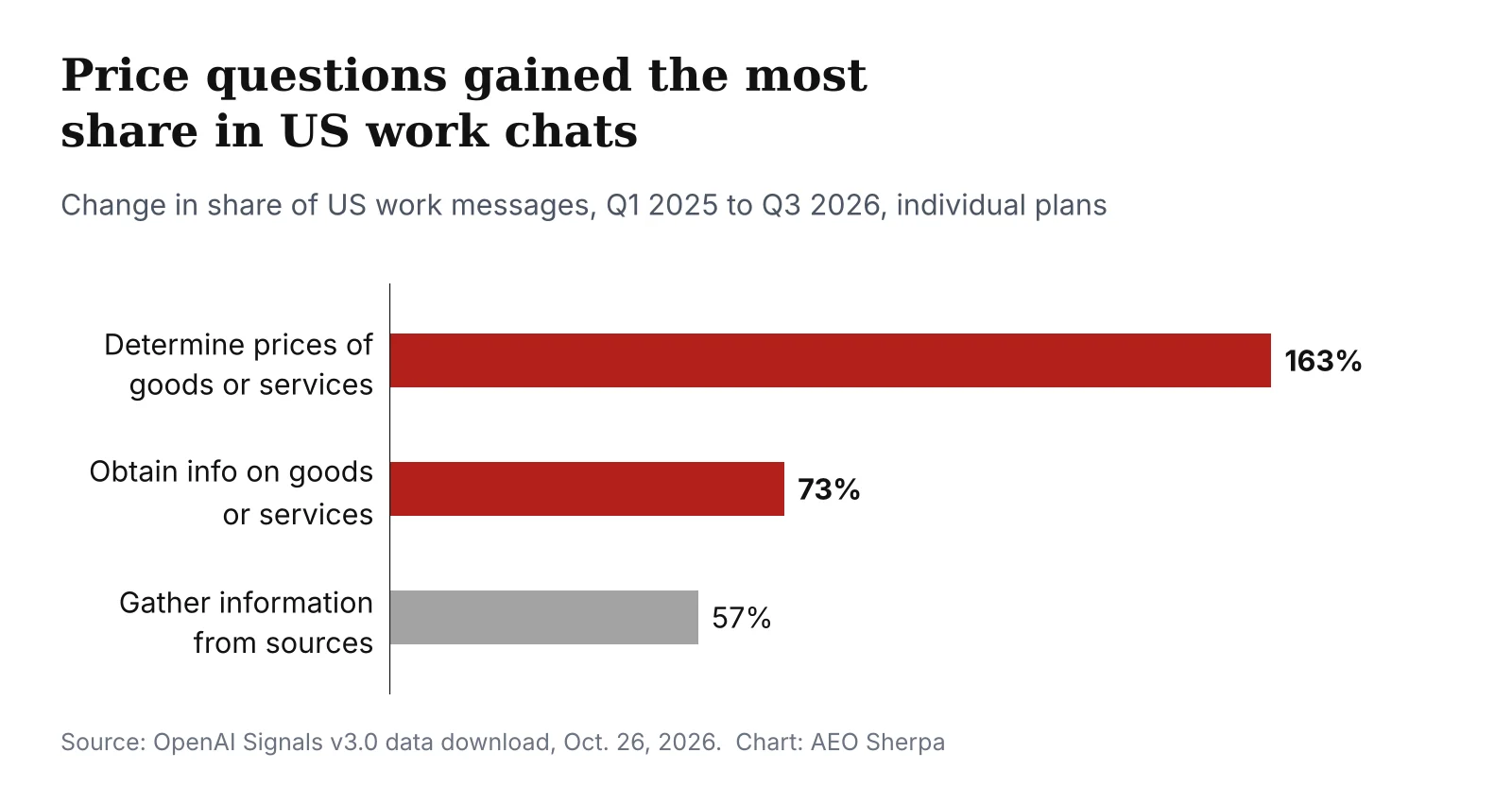
A third activity, gathering information from physical or electronic sources, rose from 1.16 percent to 1.83 percent. It is broader and does not by itself mean product research. Add all three and the combined share goes from 3.11 percent to 5.44 percent, up 75 percent, but I would lean on the first two.
The research activities went the other way. Research on technology designs or applications fell from 1.50 percent to 0.51 percent. Research on historical or social issues fell from 1.43 percent to 0.51 percent. Research on healthcare issues fell from 1.54 percent to 0.89 percent. The first two lost about two thirds of their share.
The coverage that did appear took a different angle. Search Engine Journal's Matt G. Southern reported that information seeking made up 20.7 percent of consumer messages in August, close to writing at 20.6 percent. Writing moved back ahead in September, at 21.4 percent against 20.2 percent. He adds that the category folds together facts, product questions and recipes. He also describes the sample as about one million messages a month from adults on Free, Go, Plus and Pro plans.
Southern points to a limit that matters for AEO. Southern writes that Signals tracks topics but says nothing about how often ChatGPT reached outside websites or cited a site. He also notes that each Signals update revises earlier months. I am citing v3.0 throughout for that reason.
That gap is why I will not tell you pricing pages win citations. A bigger share of price questions does not show which pages answer them. The file shows the questions moving from explaining a subject toward asking what a thing costs and what it does.
My guess is that pricing and help pages are the ones most B2B sites treat as an afterthought, and the question they answer is the one gaining share. That is a bet, and asking ChatGPT your buyers' price and fit questions is a cheap way to see who gets named.
Free newsletter
The Sherpa Brief
One email a week on what changed in AI search, what it means, and what to do about it. Written for marketers, SEOs, and publishers.
Free. Unsubscribe in one click.