
You've probably put "AI Overviews" on the slide that explains last quarter's organic drop. Two reports from the same morning question that slide.
Search Engine Roundtable reported that AI Overviews now show for over 80% of Google searches. Kevin Indig's Growth Memo used Similarweb estimates for 8,658 US sites and found organic search visits fell 13.2% between August 2024 and August 2026, while paid search visits rose 21%. The first number counts how often the box appears. The second counts visits, and AI referrals were only 0.5% of the total.
I think "AI ate our traffic" is the easiest sentence to write and the least tested. Test the competing explanations before it goes in the report.
Both pieces ran on October 26, 2026, and they measure different things.
Indig's panel is Similarweb's monthly traffic estimates for 10,000 domains each in the US and France, September 2023 through August 2026. The two-year organic comparison uses the 8,658 US sites and 7,730 French sites with complete estimates. The site lists differ by country and do not represent the national web. Indig writes in his methodology note, "The findings describe modeled visits, not unique people, spending or revenue, and do not establish whether AI or paid search caused organic-search losses."
Within those limits, the numbers are plain. US organic visits went from 19.9 billion to 17.3 billion. France went from 4 billion to 3 billion, a 24.4% drop. Paid search visits rose 21% in the US and 17.3% in France.
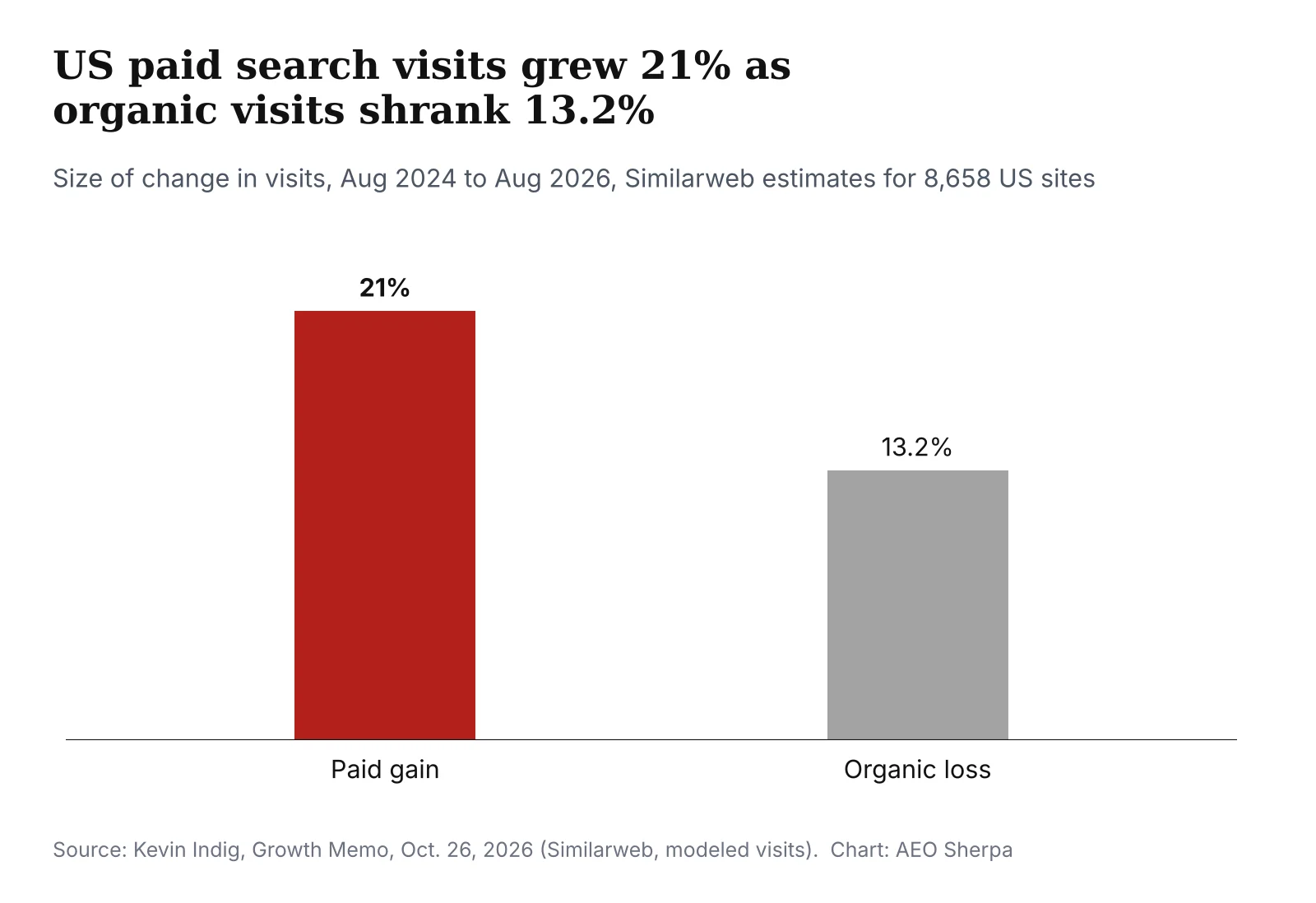
In raw visits, the US paid gain equals about 36.6% of the organic loss. In France it equals 6.7%.
The loss is lopsided. Publishers lost 41.5% of organic traffic in the US and 42.5% in France. Without publishers, the US decline is 7.8% and the French decline is 22.5%. That shows where the losses sit. The panel cannot say why.
By total visits, small US sites gained 19.3% in organic traffic while large ones lost traffic. Indig cautions that a minority of small sites drove that gain. Remove the 100 biggest small-site gainers in each country and the combined growth turns negative.
Indig's argument is about ads. He says Google shows them before it shows AI Overviews and that they take up more space than people credit. Then he makes his claim: "In other words, ads eat into organic clicks as well and I think we massively underestimate the impact and misattribute it to AI Overviews."
He also used France as a rough control. Google launched AI Overviews there in July 2026, yet the French panel lost organic traffic faster over two years. Indig traces that gap between the countries mostly to which sites are in each panel. On the same 1,725 sites in both countries, organic visits per day fell 5.1% in France and 3.6% in the US between June and August 2026. He adds that this comparison cannot isolate how much of the change came from AI Overviews.
AI referrals are small by comparison. They equal 2.85% of SEO traffic in the US and 2.44% in France. Against all visits, Indig puts them at 0.5%, roughly one in 200.
On the 80%, Barry Schwartz cites Semrush, SE Ranking and seoClarity without tying the headline figure to one sample. The pieces behind it are narrower. SE Ranking's 82.5% covers US brand searches. seoClarity told Schwartz it sees AI Overviews on over 62% of queries, from 55% to 84% by industry. The earlier readings he cites were 50% in June of last year and about 15% the year before.
Coverage also moves by category. Glenn Gabe, who watches this in Search Console, wrote on X, "AIOs definitely expanded to some ultra-YMYL categories this fall. Saw that explode in GSC in Sep while clients picked it up almost immediately." He adds that those AI Overviews are now dropping back. One number for all searches smooths that out.
My read is that none of this clears AI. Indig says himself that his data cannot assign blame. But a drop in organic visits has several suspects, and ad load and update dates are the two you can check on your own results pages. Pull the ad blocks above your head terms, line your decline up against Google's update dates, and see what is left to explain. I would rather have that answer than the slide.
Free newsletter
The Sherpa Brief
One email a week on what changed in AI search, what it means, and what to do about it. Written for marketers, SEOs, and publishers.
Free. Unsubscribe in one click.