
You check whether ChatGPT still cites your page, find it gone, and assume the searches behind the answer changed. Ahrefs data says that explains only part of it.
When ChatGPT ran exactly the same web searches as the day before, its cited websites still changed 81% of the time. When the searches changed, it was 91%. Ahrefs followed about 37,500 citations across five AI tools for 20 days to get there.
Ahrefs reads that as churn after the search, when the model decides which pages to cite. That is an inference from identical queries, not a look inside ChatGPT. Either way, I think a single citation check is close to noise.
Mateusz Makosiewicz, an SEO and marketing educator at Ahrefs, published the study on October 29, 2026. His colleague Xibeijia Guan ran the data and Ryan Law reviewed it.
Guan asked five AI tools the same questions every day for 20 days. She took every website cited on day one and followed it. Did it get cited the next day, and the day after? If it vanished, did it come back? The sample was 1,996 questions for Google AI Mode, 3,173 for ChatGPT, 563 for AI Overviews, 1,276 for Gemini and 823 for Copilot.
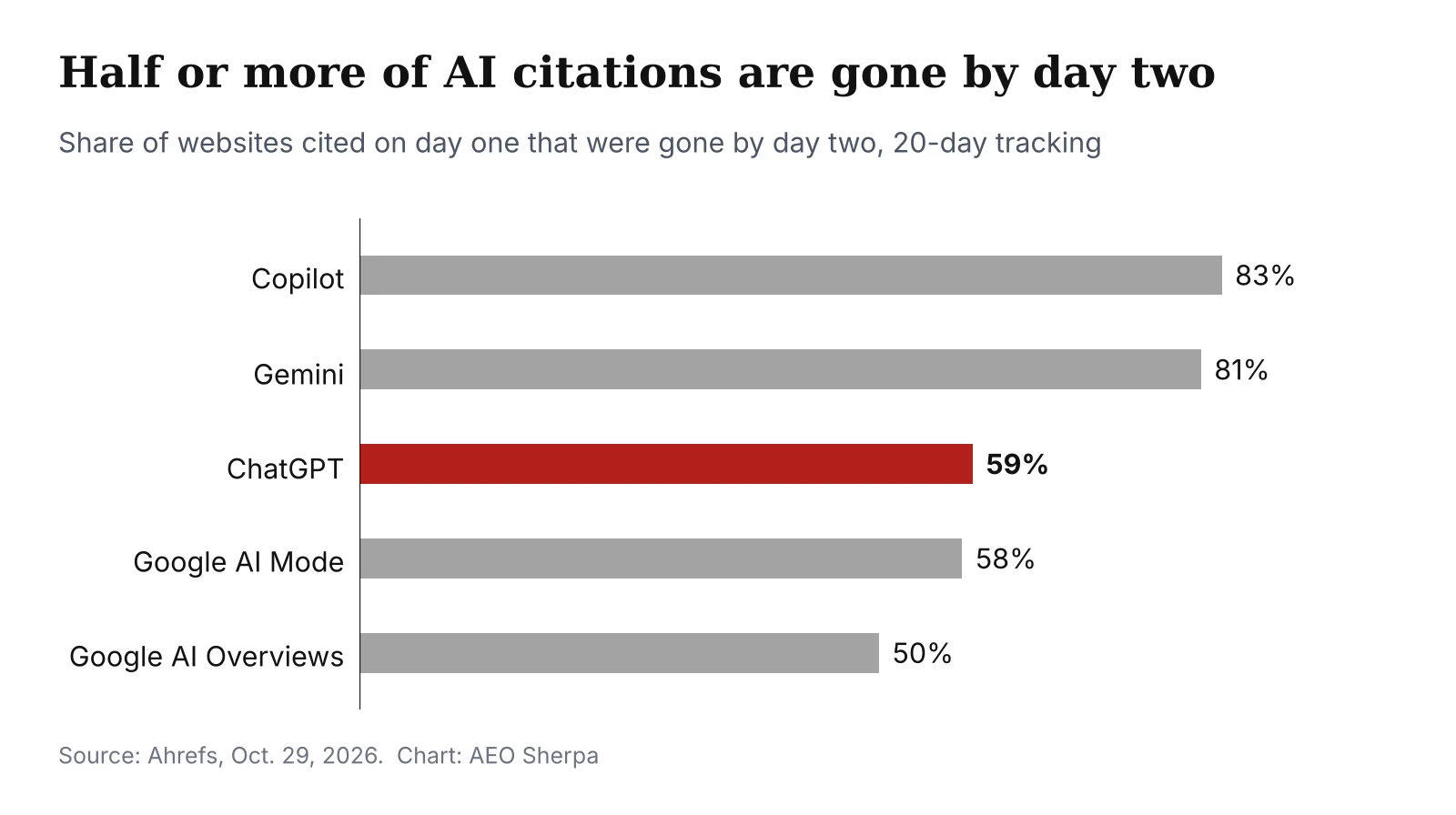
Half or more of the citations were gone by day two on every tool. AI Overviews lost 50%, AI Mode 58%, ChatGPT 59%, Gemini 81% and Copilot 83%. Only 4.0% of ChatGPT citations lasted all 20 days. AI Overviews kept 6.6% and AI Mode 6.8%.
The searches were not the whole story
The obvious suspect is fan-out. Before answering, these tools run several web searches, and different searches should surface different pages. ChatGPT repeated exactly the same searches as the previous day only 26% of the time. The suspect has a case.
Then comes the line I would have underlined. In Makosiewicz's words, "Even when the searches stayed the same, its cited websites changed 81% of the time, compared with 91% when the searches changed. This suggests much of the churn happens after the search, when the AI decides which pages to cite."
The gap between 81% and 91% is ten points. The 81% is the part to sit with. Identical queries do not guarantee identical results. Ahrefs is inferring the pick step, not observing it. Still, a citation that disappears is weak evidence that something about your page changed.
Most lost citations come back
The disappearing act is not permanent. About 75% of citations that went missing returned within the 20 days, according to Ahrefs. Ahrefs also tells readers to count how many of the last seven days a page was cited, rather than judge visibility from one check.
That fits how I think about this. A page can be read in one run and cited in the next, because retrieval and citation are different events. A one-off snapshot only captures one of them.
Names outlast links
One table covers brand mentions: how often a cited website was named in the answer text. AI Mode cited a site without naming the brand 84% of the time, Copilot 81%, AI Overviews 77%, Gemini 60% and ChatGPT 54%.
Names also lasted longer. On every tool, about 50 to 70% of cited websites showed up on only one day. For brand names, it was about one in five.
Lily Ray, an SEO consultant, put it on X the same day: "If you’re only counting citations you might be missing the bigger picture". It is one post. I treat it as color rather than a finding. Ahrefs draws its own conclusion. Its key takeaways say "AI citations might not be a great AEO KPI" and that brand mentions look like a better candidate because they are more stable. Ahrefs sells an AI visibility tracker, Brand Radar and has a stake in how people measure this. The data here is its own and the table is easy to check against your own logs.
Where the basics still hold
Pages that rank in Google for the question were cited for a week or more 29% of the time in AI Overviews, against 4% for pages that do not rank. In AI Mode it was 28% against 4%. On ChatGPT the gap was smaller, 11% against 4%, which fits a model that leans less on Google's results.
Ranking is not required to be cited, though. Ahrefs found that around 75% of pages cited by AI Mode and ChatGPT did not rank in Google for the same question.
What I take from it
I have said for a while that recommendations and brand mentions are the outcome that matters, and that citations are diagnostics. This study does not prove that. It does remove one of the better arguments against it, because a diagnostic that flips on identical searches needs many repeated runs before it means anything.
The counterpoint is fair. Answers are stochastic, and nobody outside the labs has prompt volume data. A mention rate is also a sample of a distribution, not a measure of who actually saw it. Repeated, controlled runs can show how often you appear. They cannot show how many people read the answer.
My read is that an isolated citation check tells you almost nothing and a rate across many prompts and runs tells you something real. I would report a seven-day citation rate next to a brand-mention rate and judge the work on whether people ask for the brand by name. Disclosure: my agency, ViewEngine, sells AI visibility work and builds its own tracking tools.
Free newsletter
The Sherpa Brief
One email a week on what changed in AI search, what it means, and what to do about it. Written for marketers, SEOs, and publishers.
Free. Unsubscribe in one click.